DIAGNOSTICS
Car AC Not Blowing Cold? Here's What Could Be Wrong

You get in the car on a hot day, crank the AC, and nothing but lukewarm air comes out. Or maybe it starts cool and then slowly gets warmer. Or it works on the highway but not at idle. Whatever the specific symptom, the result is the same -- you're sweating, and something is wrong with your car's air conditioning.
At P&C Repair in Thomaston, AC complaints are one of the most common things we see once temperatures start climbing in Connecticut. Here's a rundown of the most likely causes, how to tell the difference, and what each one typically involves to fix.
The Most Common Cause: Low Refrigerant
If we had to pick one reason that covers the majority of "AC not blowing cold" complaints, it's low refrigerant. Your AC system relies on a precise charge of refrigerant to absorb heat from the cabin air. When that charge drops, cooling capacity drops with it.
How it feels: The AC blows, but the air is cool rather than cold. On mild days it might seem adequate. On a hot, humid Connecticut afternoon, it can't keep up. As the refrigerant gets lower, the air gets progressively warmer until eventually the compressor won't even engage (most systems have a low-pressure cutoff switch that prevents the compressor from running without enough refrigerant, protecting it from damage).
The important question is why is the refrigerant low? Refrigerant doesn't get "used up" like gasoline. If it's low, it leaked out somewhere. Common leak points include:
- O-ring seals at connections: Rubber O-rings dry out and shrink over time, especially through years of Connecticut temperature extremes. These are often the cheapest leaks to fix.
- Condenser: Mounted at the front of the vehicle, the condenser catches road debris. A rock chip can puncture it.
- Evaporator: Located inside the dash. Evaporator leaks are expensive to access but not uncommon on older vehicles.
- Hoses and lines: Rubber hoses degrade with age. Metal lines corrode -- road salt accelerates this in Connecticut.
- Compressor shaft seal: The seal where the compressor shaft exits the housing can develop leaks, especially after long periods of non-use over winter.
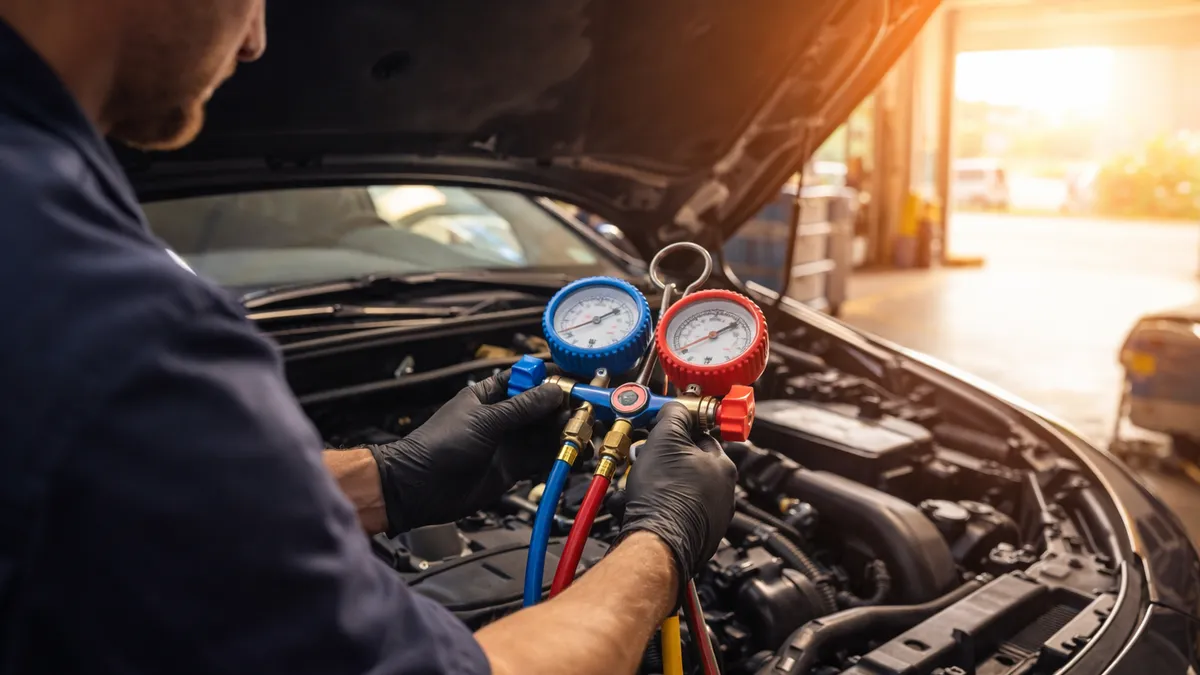
A proper AC diagnosis includes checking the refrigerant charge level and performing a leak detection test if it's low. Finding and fixing the leak before recharging ensures you're not just wasting money on refrigerant that will leak out again.
Compressor Failure
The compressor is the pump that drives the entire AC system. When it fails, you get zero cooling. Compressor problems present in a few different ways:
- Compressor clutch not engaging. You turn on the AC and the compressor clutch doesn't click on. You can sometimes hear the difference -- the engine RPMs should dip slightly when the AC compressor engages. If there's no change, the compressor isn't running. This could be the compressor itself, or it could be an electrical issue (relay, fuse, pressure switch) preventing the clutch from engaging.
- Loud noise when AC is on. A failing compressor often announces itself with grinding, squealing, or rattling noises that appear only when the AC is turned on. If you hear new noises when you hit the AC button, get it checked before the compressor seizes completely.
- Compressor seizes. When a compressor locks up, it can snap the serpentine belt since the compressor pulley is in that belt's path on most vehicles. If your serpentine belt suddenly breaks and you smell something acrid, a seized compressor may be the cause.
Compressor replacement is the most expensive common AC repair, typically running $800-$1,500 including related components and a system recharge. When a compressor fails internally, metal debris contaminates the system, so the receiver/drier, expansion valve, and sometimes the condenser need to be replaced or flushed as well.
Blend Door Actuator Problems
This one fools a lot of people -- and even some shops. The AC system is working perfectly. Refrigerant charge is full, compressor is running, cold air is being produced. But the air coming out of the vents is warm or only slightly cool.
The culprit is often the blend door actuator. This small electric motor controls a door inside the HVAC housing that directs air either through the heater core (for heat) or the evaporator (for cold). When the actuator motor fails or the door gets stuck, the air routing gets mixed up.
Common signs of a blend door problem:
- One side of the car blows cold and the other blows warm (on dual-zone systems)
- You hear a clicking or ticking noise behind the dashboard when adjusting temperature
- The temperature doesn't change when you adjust the dial or buttons
- The system blows hot regardless of the setting
The actuator itself is a $30-$80 part. Labor ranges from straightforward to significant depending on where it's located in the dash. Some are accessible behind the glovebox in 30 minutes. Others require substantial dashboard disassembly.
Condenser Problems
The condenser sits in front of the radiator and dissipates heat from the refrigerant. Two things commonly go wrong:
- Blocked condenser: Bugs, leaves, dirt, and road debris can clog the condenser fins, reducing airflow and cooling capacity. This is especially common in spring and summer. Sometimes a careful cleaning with a garden hose (low pressure, from the engine side out) restores performance.
- Condenser fan failure: Many vehicles have a dedicated fan for the condenser (or a shared fan with the radiator). If this fan fails, the condenser can't shed heat at low speeds or idle. The AC might work fine on the highway (where airflow through the grille cools the condenser) but blow warm in stop-and-go traffic or at stoplights. If your AC only fails in traffic around Waterbury or at idle, suspect the condenser fan.
Expansion Valve or Orifice Tube Issues
The expansion valve (or orifice tube, depending on your system) meters refrigerant flow into the evaporator. When it gets clogged with debris or sticks open/closed, the system can't regulate properly.
Signs include:
- Inconsistent cooling -- cold sometimes, warm other times
- The evaporator icing up (you might see frost on the AC lines under the hood or water dripping excessively from under the dashboard)
- The compressor cycling on and off rapidly
Expansion valve replacement is often done at the same time as other AC work since it's relatively inexpensive and accessing it requires opening the system anyway.
Electrical Issues
Before assuming the worst, some AC problems have simple electrical causes:
- Blown fuse: Check the AC-related fuses in both the under-hood and interior fuse boxes. A blown fuse can disable the compressor clutch.
- Bad relay: The compressor clutch relay can fail, preventing the compressor from engaging. Relays are inexpensive and easy to swap.
- Wiring issues: Corroded connectors or damaged wiring -- not uncommon in Connecticut with our salt and temperature extremes -- can cause intermittent AC operation.
- Pressure switch: AC systems have high and low pressure switches that shut down the compressor to protect it. A faulty switch can disable the system even when pressures are normal.
Quick Troubleshooting Before You Visit the Shop
Before scheduling an appointment, you can narrow things down:
- Does the AC compressor engage? With the engine running and AC on max, listen for a click from under the hood and watch for a slight RPM dip. If the compressor isn't engaging, the problem is either electrical or the system is too low on refrigerant to activate the low-pressure cutoff.
- Does it cool on the highway but not at idle? This points to a condenser fan problem or a system that's slightly low on refrigerant.
- Does one side blow cold and the other warm? Blend door actuator issue (dual-zone systems).
- Do you hear clicking behind the dash? Blend door actuator.
- Is there a musty smell when the AC first turns on? That's mold or mildew on the evaporator. Not an AC performance problem, but worth addressing -- an evaporator cleaning takes care of it.
AC Diagnosis at P&C Repair
If your car's AC is not blowing cold, bring it to P&C Repair in Thomaston. We'll check the system pressures, verify the compressor operation, inspect for leaks, and identify exactly what's causing the problem. We don't guess, and we don't just throw refrigerant at it and hope for the best.
We handle AC recharges and compressor replacements for all makes and models. Whether it's a simple recharge or a compressor swap, we'll give you a clear diagnosis and an honest estimate before doing any work.
P&C Repair is located at 64 N Main St in Thomaston, CT -- convenient for drivers from Waterbury, Plymouth, Bristol, Torrington, and the surrounding area. Call (860) 601-0271 to schedule an AC diagnosis. Pro tip: don't wait until July. Get it checked in spring while the schedule is open and you're not sweating in the waiting room.
Need Help With This?
If something in this article sounds like what your vehicle is going through, bring it in. We'll diagnose the issue and give you a straight answer.
Keep Reading
More from The Garage
How Much Does Car AC Repair Cost? What CT Drivers Should Expect
Car AC repair costs range from $150 for a recharge to $1,200+ for a compressor replacement. Here's what causes AC problems, what repairs involve, and realistic pricing.

Check Engine Light On? Here's What It Could Mean
Your check engine light can mean anything from a loose gas cap to a serious engine problem. Here's how to tell the difference and what to do next.

Spring Car Maintenance Checklist for Connecticut Drivers
Connecticut winters are tough on vehicles. Here's a practical spring maintenance checklist to undo winter damage and get your car ready for the warmer months ahead.
Ready to Get Your Vehicle Fixed?
Schedule your appointment today. Free estimates on all repairs -- we'll explain what needs to be done before we do any work.